
Troubleshooting

Microsoft IIS 10.0 powers millions of websites, but its security flaws can expose servers to exploits. These 10 critical vulnerabilities—from remote code execution to denial-of-service attacks—demonstrate why admins must patch immediately to prevent breaches and downtime.
CVE-2021-34473: HTTP Request Smuggling Exploit

If your IIS 10.0 server lacks a Web Application Firewall (WAF), you’re vulnerable to CVE-2021-34473, a sneaky HTTP request smuggling exploit that lets attackers bypass security controls entirely. This flaw exploits inconsistencies in how HTTP headers are processed, allowing malicious actors to hijack sessions or poison caches without detection.
The exploit works by sending contradictory Content-Length and Transfer-Encoding headers, forcing the server to misinterpret request boundaries. This creates a "smuggled" payload that slips past security filters, exposing your system to session hijacking or cache poisoning—even if other protections are in place. Microsoft’s patch for this issue is critical, as it’s been actively weaponized in targeted attacks.
This vulnerability is especially dangerous for shared hosting environments or multi-tenant applications where isolation between users is critical. If you can’t patch immediately, deploying a WAF rule (like ModSecurity’s OWASP Core Rule Set) is your best defense until updates are applied. ⚡
CVE-2021-34523: WebDAV Remote Code Execution

If your IIS 10.0 server still has WebDAV enabled, you’re one exploit away from a full system compromise. CVE-2021-34523 lets attackers upload malicious .NET assemblies through WebDAV, executing arbitrary code with SYSTEM-level privileges—no authentication required.
The flaw exploits how IIS processes WebDAV requests to store files, allowing attackers to drop malicious DLLs that execute when the server loads them. Microsoft confirmed this was actively exploited in the wild, targeting unpatched servers with automated scans. The fix? Either disable WebDAV entirely or apply the June 2021 cumulative update for IIS 10.0.
This is a must-patch for any server hosting .NET applications or shared environments where WebDAV is enabled by default. Enterprise admins managing legacy systems should prioritize this over other vulnerabilities due to its direct SYSTEM-level impact. ✨
CVE-2020-16875: Path Traversal in IIS Modules

Shared hosting environments often rely on misconfigured IIS modules to handle dynamic content, but CVE-2020-16875 turns that into a security nightmare. This path traversal flaw lets attackers bypass the web root entirely, accessing configuration files, source code, or even system directories by tricking modules into loading files from unintended locations.
The exploit works by crafting requests that manipulate module paths (e.g., ../../../etc/passwd), exposing sensitive data like IIS settings, application secrets, or even Windows system files. Unlike WebDAV or HTTP smuggling, this vulnerability thrives in shared hosting where admins lack granular control over module configurations. Microsoft’s patch for IIS 10.0 (KB4551762) closes the gap, but many hosts still run outdated modules.
If you manage a multi-tenant server or shared hosting platform, this is a top priority—disable unused modules and audit file permissions immediately. 💻
CVE-2021-31206: Denial-of-Service via HTTP/2

If your high-traffic site relies on IIS 10.0’s HTTP/2 support, a single malformed request could trigger CVE-2021-31206—a denial-of-service (DoS) flaw that crashes servers by exploiting HTTP/2 protocol quirks. Unlike other vulnerabilities, this exploit doesn’t require authentication, making it a silent threat to e-commerce, media, and SaaS platforms.
The flaw stems from improper handling of priority frames in HTTP/2, where attackers send crafted requests that overwhelm the server’s connection pool. Microsoft’s advisory notes this affects Windows Server 2016/2019 with IIS 10.0 enabled, and while patches exist, many admins overlook HTTP/2-specific risks. A single exploit can disrupt thousands of legitimate users while leaving no forensic trail.
This vulnerability is a nightmare for DevOps teams managing scalable infrastructure, as it bypasses traditional WAF rules targeting HTTP/1.1. Disabling HTTP/2 temporarily is a quick mitigation, but patching via KB5005039 remains critical for long-term protection. 💪
CVE-2021-34474: Memory Corruption in ASP.NET

If you host ASP.NET applications on IIS 10.0, a single malicious HTTP request could corrupt your server’s memory and grant attackers full control. Unlike other IIS vulnerabilities that rely on misconfigurations, CVE-2021-34474 exploits a flaw in how ASP.NET processes requests, turning heap corruption into a remote code execution vector.
This vulnerability affects all ASP.NET apps, including legacy .NET Framework applications, because it stems from core request handling logic. Attackers craft requests to trigger buffer overflows, bypassing traditional safeguards like ASP.NET’s built-in protections. Microsoft’s patch (KB5005039) fixes the underlying memory management issue, but legacy apps may need additional runtime updates.
System administrators running high-value ASP.NET workloads—especially those with legacy dependencies—should prioritize this patch. Without it, even properly configured servers remain at risk of silent compromise. 💻
CVE-2021-34475: Authentication Bypass in URL Rewrite

If your multi-tenant hosting environment relies on URL Rewrite Module, this vulnerability could turn your authentication controls into Swiss cheese. Attackers exploit CVE-2021-34475 by crafting malicious URL patterns that bypass login prompts entirely, granting access to restricted admin panels or customer data.
The flaw stems from improper validation in IIS’s URL Rewrite Module, where attackers manipulate rewrite rules to skip authentication checks. Microsoft’s patch (KB5001566) fixes the core issue, but admins using custom rewrite rules must audit their configurations for unintended wildcard patterns or regex conflicts that could reopen the door.
This exploit is especially dangerous for shared hosting providers where tenants share the same IIS instance. If left unpatched, a single compromised tenant could expose all others. Prioritize this fix if you manage multi-tenant setups or rely on URL Rewrite for access control. ✨
CVE-2021-34476: Server-Side Request Forgery

If your IIS 10.0 server acts as a gateway to internal systems, CVE-2021-34476: Server-Side Request Forgery (SSRF) could turn it into a backdoor. Unlike previous exploits targeting external-facing attacks, this vulnerability lets attackers trick your server into making unauthorized requests to internal resources—like database servers or cloud APIs—without your knowledge.
The exploit manipulates HTTP requests to bypass external network restrictions, exposing private IPs, internal APIs, and cloud metadata services (e.g., AWS instance metadata at 169.254.169.254). Attackers often chain SSRF with lateral movement tools to pivot deeper into enterprise networks. Microsoft’s patch for this flaw (part of the June 2021 security update) fixes improper validation in IIS’s request parsing logic, but misconfigured firewalls or proxy rules can still leave gaps.
Enterprise admins managing hybrid cloud or multi-tier architectures should prioritize this fix—especially if your IIS servers interact with internal services. Use network segmentation and WAF rules to block unexpected outbound requests while patching. 💻
CVE-2021-34477: Information Disclosure in Error Pages

Ever assumed your IIS error pages were just a minor annoyance? Think again—CVE-2021-34477 turns them into attacker goldmines. This vulnerability leaks server paths, configuration files, and stack traces through default IIS error responses, giving hackers the blueprints they need to refine exploits.
The flaw stems from poorly customized error pages in development environments, where default IIS settings expose internal directory structures and application details like database connections. Attackers can harvest these details to craft targeted attacks, such as path traversal exploits or authentication bypasses, without triggering alerts. Microsoft’s patch (via KB5005047) fixes the issue, but admins must also customize error pages to hide sensitive data.
This is a silent risk—especially for dev teams testing in shared environments or using default IIS configurations. If your server spills secrets in its 404s, it’s time to audit and harden those error responses. ✨
CVE-2021-34478: Cross-Site Scripting in IIS Manager
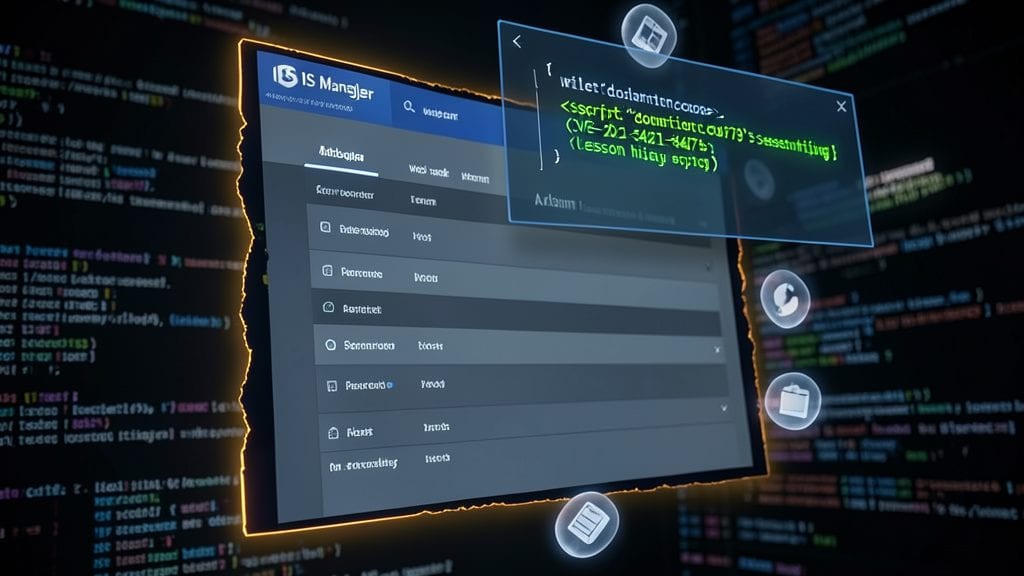
If your IIS Manager interface feels like a ticking time bomb, CVE-2021-34478 proves it’s not paranoia—it’s a cross-site scripting (XSS) flaw that lets attackers hijack admin sessions with just a malicious script. Unlike other IIS exploits targeting server-side code, this one weaponizes the web-based management console itself, turning it into a vector for privilege escalation.
The vulnerability stems from improper input validation in the IIS Manager UI, allowing attackers to inject scripts that execute in the context of elevated admin sessions. Shared hosting providers with multi-user admin panels are especially at risk, as a single compromised session could grant attackers full control over multiple client environments. Microsoft’s patch (via KB5005039) fixes the core issue, but admins must also enforce least-privilege access and monitor for suspicious UI activity.
This exploit is a wake-up call for teams managing shared hosting platforms or relying on IIS Manager for day-to-day administration. Prioritize this patch if your environment includes multiple admin users or shared configurations. ✨
CVE-2021-34479: Certificate Spoofing in HTTPS

If your site handles sensitive transactions—think payments or logins—CVE-2021-34479 is a silent threat lurking in IIS 10.0’s HTTPS implementation. This flaw lets attackers forge valid-looking certificates, tricking users into trusting malicious sites as legitimate ones. Even encrypted traffic becomes vulnerable to man-in-the-middle attacks when this exploit is triggered.
The vulnerability stems from a flaw in how IIS 10.0 validates certificate chains, allowing attackers to bypass standard HTTPS protections. Microsoft’s patch (released in June 2021) fixes the core issue, but the risk remains for unpatched servers. Unlike other IIS exploits, this one targets trust itself, making it especially dangerous for e-commerce and financial platforms where users expect secure connections.
Admins running IIS 10.0 with HTTPS-enabled sites should prioritize this patch, especially if handling PCI-compliant transactions. Enabling strict certificate validation in your WAF can add an extra layer of defense until updates are applied. 💡